
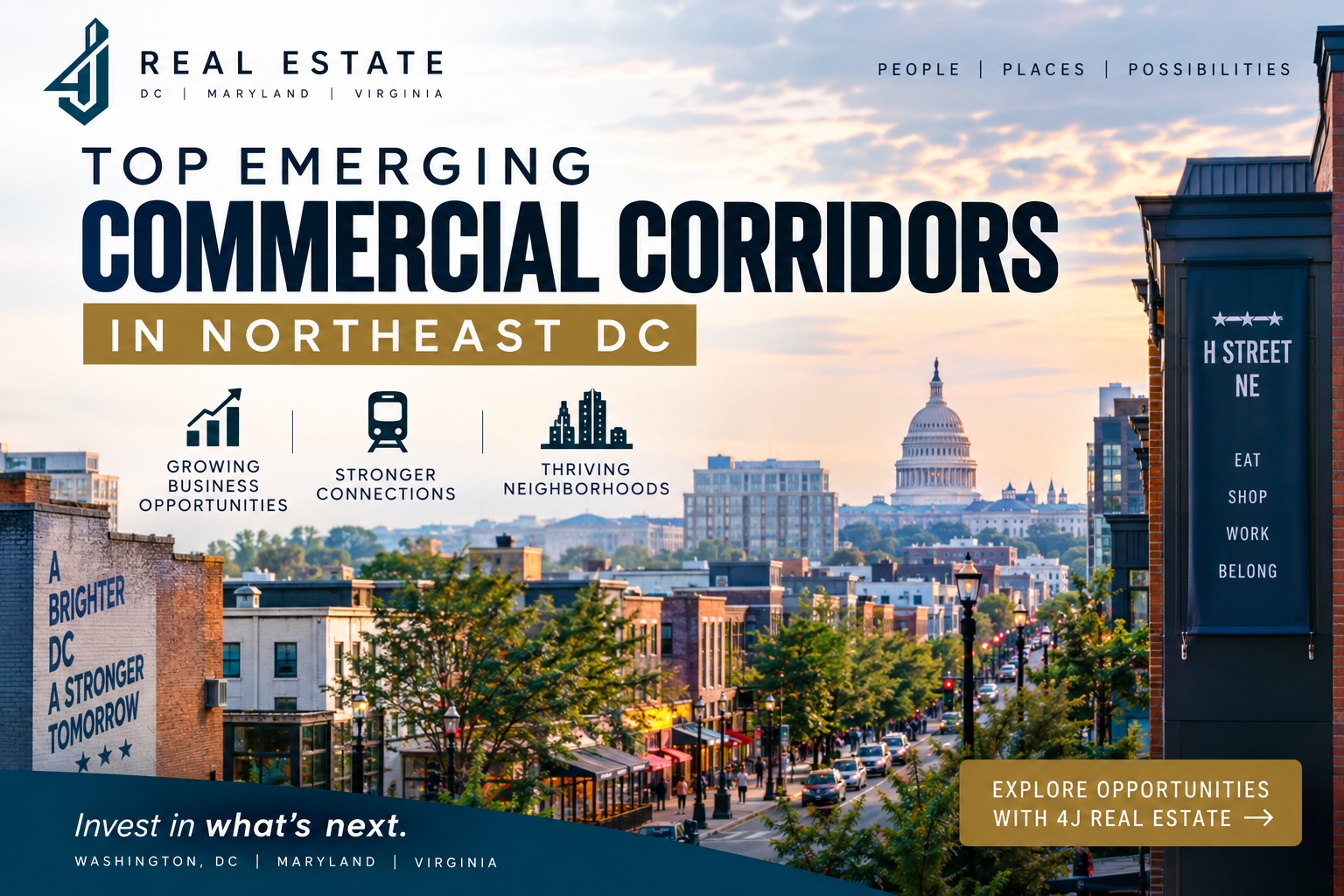
Top Emerging Commercial Corridors in Northeast DC
Washington, DC’s commercial real estate market is evolving, and some of the most interesting opportunities are taking shape beyond the city’s traditional downtown business districts.
For buyers and investors looking for potential growth, Northeast DC commercial real estate deserves attention. Corridors once known primarily for industrial uses, warehouses, auto-oriented businesses, or neighborhood retail are gradually becoming more mixed-use. New housing, infrastructure improvements, restaurants, retail concepts, and community-focused development are changing how people live and do business across Northeast Washington.
For first-time commercial property buyers, understanding where this growth is occurring—and what to evaluate before purchasing—is an important first step.
Here are several Northeast DC commercial corridors worth watching.
1. Rhode Island Avenue NE
Rhode Island Avenue NE may be one of the most interesting corridors for buyers looking beyond DC’s already-established commercial districts.
The corridor connects Washington with Maryland and passes through neighborhoods including Brentwood and Woodridge. Around the Rhode Island Avenue-Brentwood Metro station, residential development has helped create additional demand for neighborhood retail and services. Rhode Island Row alone includes 274 apartments and approximately 70,000 square feet of retail and restaurant space.
The DC Office of Planning is also focusing on the eastern portion of Rhode Island Avenue NE. A planning study released in late 2025 recommends strategies to support existing businesses, attract new businesses, improve pedestrian conditions, create gathering spaces, and expand housing options.
For commercial buyers, that combination of housing, transportation access and public investment makes Rhode Island Avenue a corridor to monitor.
2. New York Avenue NE and Ivy City
New York Avenue NE has historically been one of DC’s major industrial, transportation and commercial gateways. Its future, however, could look considerably different.
The District’s New York Avenue NE Vision Framework lays out a long-term transition toward a mixed-use community with new housing, jobs, retail, public spaces and infrastructure. The framework envisions a corridor where more than 20,000 people could eventually live, while maintaining an important role for employment and industrial uses.
That makes areas such as Ivy City particularly noteworthy.
Commercial investors may find opportunities ranging from retail and service businesses to mixed-use and adaptive-reuse properties. However, buyers should carefully research zoning and land-use restrictions because portions of the New York Avenue corridor continue to serve important production, distribution and repair functions.
The transformation will likely happen over many years rather than overnight—which is exactly why long-term investors may want to understand the corridor now.
3. H Street NE and the Benning Road Gateway
H Street NE is no longer an undiscovered commercial corridor, but development along and beyond its eastern end continues to make this part of Northeast DC worth watching.
The historic H Street commercial district stretches roughly from Union Station to 17th Street NE and has undergone significant revitalization. Newer residential development is adding customers to the surrounding commercial environment as well. Recent projects cited by the Washington DC Economic Partnership include 191 residential units with 7,900 square feet of retail at 1701 H Street NE and the 148-unit Paxton development along Benning Road.
For buyers, opportunities may include neighborhood retail, restaurants, professional services and smaller mixed-use properties serving nearby residents.
Instead of looking only at established H Street blocks, investors should also pay attention to how commercial activity extends toward Benning Road and surrounding neighborhoods.
4. North Capitol Street and Northeast Gateway Areas
North Capitol Street sits at the boundary of Northeast and Northwest DC, but its connections with New York, Rhode Island and Florida avenues make it important to the broader Northeast commercial landscape.
The Washington DC Economic Partnership identifies these corridors as gateways into the city and notes residential development in the pipeline alongside retail and commercial opportunities.
For smaller commercial buyers, properties serving everyday neighborhood needs may be particularly interesting. Think restaurants, personal services, professional offices, convenience retail and other businesses that benefit when more residents move within walking distance.
What Should First-Time Commercial Buyers Know?
Buying commercial property is different from buying a home.
Before touring properties, determine how you intend to use the building. Are you purchasing space for your own business? Buying a property to lease to tenants? Looking for a mixed-use building with residential units above commercial space?
That decision affects everything from financing and zoning to projected income.
Next, assemble a team that understands commercial transactions. Your real estate broker, lender, attorney, inspector and other advisers can help you evaluate zoning, leases, operating expenses, property condition and potential returns.
Finally, conduct thorough due diligence. An attractive location does not automatically make a property a good investment. Buyers should examine existing leases, vacancy, comparable rents, taxes, insurance, maintenance expenses, permitted uses and planned development nearby.
3 Actionable Tips for Northeast DC Commercial Buyers
1. Follow development before it is completed.
Track DC planning studies, zoning activity, residential projects and infrastructure improvements. These can provide clues about where future customers and commercial demand may emerge.
2. Study the surrounding residential pipeline.
New apartments and homes can create demand for restaurants, fitness concepts, medical services, childcare, convenience retail and other neighborhood businesses.
3. Verify zoning before making assumptions.
This is especially important along industrial and transitioning corridors such as New York Avenue NE. Confirm that your intended use is permitted before committing significant time or money to a property.
The Opportunity in Northeast DC
Northeast Washington is not one single commercial market. H Street offers a different environment from Rhode Island Avenue, and Rhode Island Avenue differs substantially from New York Avenue and Ivy City.
That diversity is part of the opportunity.
DC’s broader development picture also continues to shift toward housing, retail and community-oriented investment even as traditional office construction has slowed, according to the Washington DC Economic Partnership’s 2025/2026 development report.
For commercial buyers, the key is not simply finding the “next hot neighborhood.” It is identifying corridors where demographics, development, transportation, zoning and your investment strategy align.
Whether you are exploring commercial real estate in Washington, DC, Maryland or Virginia, having local guidance can help you evaluate both the opportunity and the risks.
Interested in buying commercial real estate? Contact 4J Real Estate to discuss opportunities throughout Washington, DC, Maryland and Virginia.
Posted by Justin Paulhamus on
Enjoy this blog post? Click here to subscribe for updates
Leave A Comment